
On August 20, 2026, construction started on The Foundry District, a 23-acre project on the old Fittings factory lands in downtown Oshawa that its developer describes as one of the largest downtown revitalizations in Durham Region’s history. Here is what is being built, what stage it is at, and what it could mean for renters, homeowners and investors across Durham.
What is being built
The Foundry District is a master-planned rental community by Medallion Corporation, a Toronto-based developer and property manager. The land was home to Fittings Limited, a cast-iron manufacturer that operated there from 1902 until 1987 and once employed about 1,000 people.
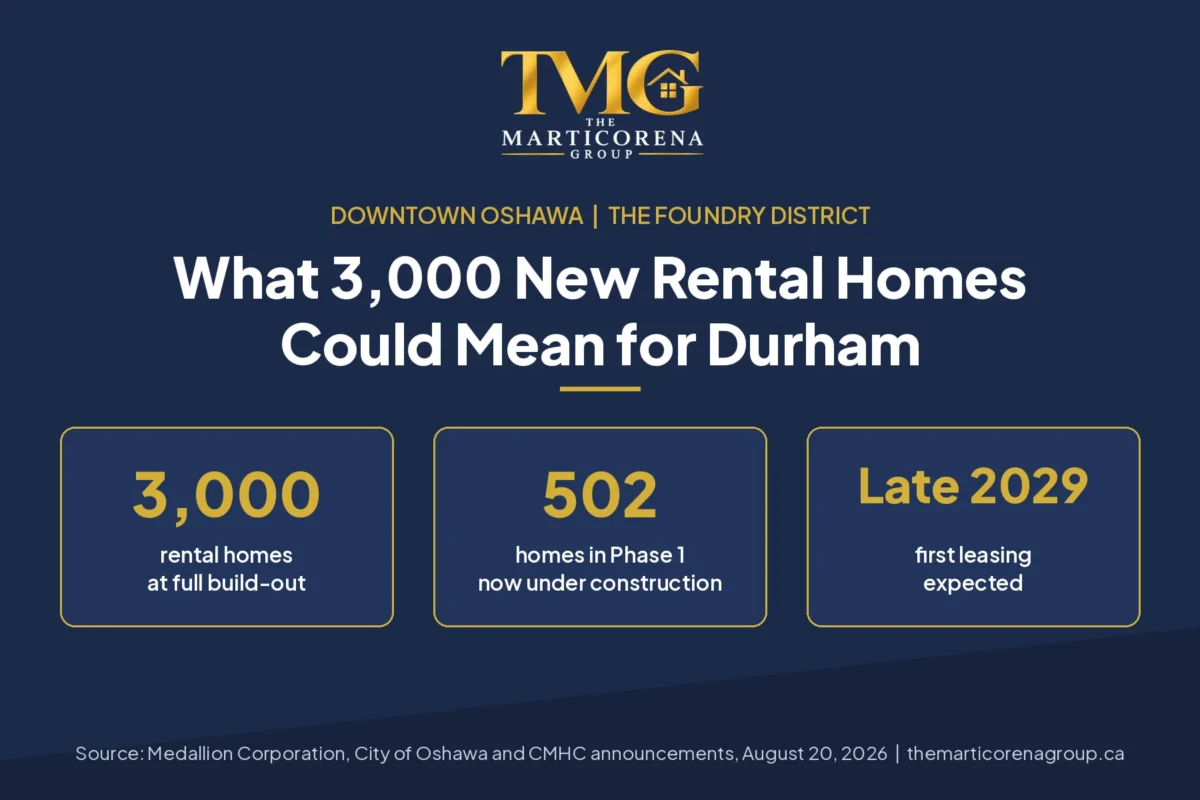
At full build-out, the plan calls for approximately 3,000 rental homes across nine buildings, with studio, one-, two- and three-bedroom suites, ground-floor retail and restaurants, and a new public park at the centre of the site where the factory floor once stood. Every home in the project is planned as purpose-built rental. There is no condominium or freehold component.
| The Foundry District at a glance | |
|---|---|
| Location | 119 and 151 Bruce Street, downtown Oshawa, on the former Fittings Limited lands |
| Site | 23 acres (9.3 hectares) |
| Full vision | About 3,000 purpose-built rental homes in nine buildings, plus retail, restaurants and a public park |
| Phase 1 (under construction) | Two buildings, 10 and 23 storeys, 502 rental homes |
| Affordability commitment | 30% of Phase 1 homes designated affordable, plus additional rent-geared-to-income homes |
| Public funding | $188 million CMHC Apartment Construction Loan Program loan; up to $3.9 million from the Region of Durham’s Regional Revitalization Program; about $3.9 million from the City of Oshawa |
| Construction start | August 20, 2026 |
| First leasing expected | Late 2029 |
Source: Medallion Corporation and City of Oshawa construction announcement (August 20, 2026); Canada Mortgage and Housing Corporation funding announcement (August 20, 2026); thefoundrydistrict.ca.
Where things stand today
Only Phase 1 is under construction: a 10-storey building and a 23-storey building with 502 homes between them. Medallion expects leasing to begin in late 2029, which means the first residents are still about three years away. The remaining seven buildings have no announced construction dates, and the developer has not published a timeline for full build-out. That matters: a 3,000-home community will take many years to complete, and the number that will actually shape the neighbourhood over the next few years is 502, not 3,000.
The project is backed by a $188 million loan through CMHC’s Apartment Construction Loan Program, the federal program designed to get more purpose-built rental built, and Phase 1 comes with a commitment that 30% of its homes will be designated affordable, with rent-geared-to-income homes on top of that. Specific rents have not been published.
Why this is a big deal for Durham’s rental market
The best way to understand the scale is to compare it with what already exists. According to CMHC’s October 2025 Rental Market Survey, the Oshawa census metropolitan area (which covers Oshawa, Whitby and Clarington) had a purpose-built rental universe of 13,551 units, a vacancy rate of 3.6% and an average rent of $1,748 across all unit types.
Set against that, The Foundry District’s full plan of roughly 3,000 homes is equivalent to about 22% of the area’s entire purpose-built rental stock, and Phase 1 alone is equivalent to nearly 4%. Even accounting for the years it will take to deliver, that is a meaningful addition of professionally managed rental housing to the area.
For comparison, CMHC now considers a vacancy rate of 2.5% to 4.0% balanced for the Toronto area, and Oshawa’s 3.6% sits inside that range. CMHC’s June 2026 Mid-Year Rental Market Update reported that asking rents in the Toronto region were easing as newly completed buildings competed for tenants, with landlords increasingly offering incentives. Durham-specific rent data for 2026 will not be published until CMHC’s next survey, so we cannot yet say how far that softening has reached Oshawa.
TMG’s interpretation: new purpose-built supply on this scale generally gives tenants more choice and puts some competitive pressure on landlords, especially for newer units. It does not automatically mean lower rents across the board, and the affordable and rent-geared-to-income homes will be allocated under their own rules. The honest answer for now is that the effect will arrive gradually, starting in 2030, and will depend on how quickly the later phases follow.
What it could mean for downtown Oshawa
Downtown Oshawa already has the Tribute Communities Centre, the Regent Theatre, the Robert McLaughlin Gallery and Ontario Tech University’s downtown location, with Oshawa GO and VIA Rail service a few minutes to the south. What it has lacked is a large, permanent residential population living within walking distance of those amenities.
Our read is that this is the more important story for homeowners. Several thousand new residents, plus retail, restaurants and a park, would change the daily life of the core in a way that is hard to achieve with policy alone. Whether that translates into higher property values nearby is not something the evidence can confirm today, and we would be cautious of anyone who says otherwise. What can be said is that the direction of change for central Oshawa is toward more people, more activity and more amenities.
For context, Oshawa remains the most affordable of Durham’s larger communities. In August 2026 the MLS® Home Price Index benchmark for a typical Oshawa home was $705,200, compared with $811,000 for Durham as a whole, and Oshawa recorded the most sales in the region that month. You can find the full picture in our August 2026 Durham Region Market Update.
What it means for you
If you rent, or plan to. Nothing changes before late 2029, but a large supply of new, professionally managed homes near downtown amenities is coming. Watch for Medallion’s leasing announcements and for details on how the affordable homes will be allocated.
If you own a home in central Oshawa. This is a significant long-term change for the neighbourhood’s amenities and activity, and it is worth understanding what is planned around you. Construction on a 23-acre site will also mean years of activity next door, which is something to factor into any near-term selling plans.
If you are an investor or small landlord. Professionally managed rental buildings with amenities are a different product from a rented condo or house, but they compete for the same tenants. If your Durham investment strategy depends on rent growth, the arrival of this much purpose-built supply, and the broader easing CMHC is seeing across the Toronto area, are reasons to plan on realistic rent assumptions rather than count on conditions tightening again.
If you are a buyer considering Oshawa. Downtown revitalization is a reason to look closely at central Oshawa, but it is a slow process. Buy a home on its own merits and treat the Foundry District as a bonus that will unfold over a decade, not a guarantee.
What we will be watching
Three things will tell us how this project is tracking: whether Phase 1 stays on pace for late-2029 leasing; when Medallion announces a start date for the next buildings; and what CMHC’s next Rental Market Survey shows for Oshawa vacancy and rents.
If you are wondering what downtown Oshawa’s changes mean for a home you own or a purchase you are considering, I am happy to talk it through with you, no obligation.
Julie Marticorena, REALTOR®
The Marticorena Group, LPT Realty, Brokerage
julie@themarticorenagroup.com | (416) 526-3786 | https://themarticorenagroup.ca
Explore more Durham community stories in our Local & Community Insights.
About this article: project facts are taken from the Medallion Corporation and City of Oshawa construction announcement and the Canada Mortgage and Housing Corporation funding announcement, both dated August 20, 2026, and from the developer’s project website. Rental market figures are from CMHC’s Rental Market Survey (October 2025) for the Oshawa census metropolitan area and CMHC’s 2026 Mid-Year Rental Market Update (June 9, 2026). Home price figures are from the Toronto Regional Real Estate Board’s Market Watch for August 2026. Later phases of The Foundry District have no announced timelines, and rents for the project have not been published. Interpretation and commentary are the opinion of The Marticorena Group and are not a guarantee of future market performance.
Julie Marticorena is a REALTOR® with The Marticorena Group serving Durham Region and the Greater Toronto Area. With more than 15 years of experience in financial services and a background in strategic planning, negotiation, and project management, Julie brings an analytical and organized approach to real estate. She focuses on education, transparency, and personalized guidance, helping buyers, sellers, and investors make informed real estate decisions with confidence. Julie is fluent in English and Spanish.