

The Bank of Canada just raised interest rates. Will your mortgage payment go up?
For many homeowners, the honest answer is not yet, or not at all. On October 28, 2026, the Bank raised its key rate by a quarter of a percentage point, from 2.25% to 2.5%. It was the first increase since July 2023, and Canada’s major banks followed by raising their prime rates. Whether you feel it depends on the kind of mortgage you have and when it renews.
Below: who is affected and who isn’t, what a quarter point costs in dollars, the questions to ask before a renewal, and what it means if you are buying or selling in Durham Region or the GTA.
What the Bank decided, and why
The Bank’s concern is inflation. It has been around 3% since April and is expected to reach about 3.5% by year end, mostly because of high oil prices linked to the conflict in the Middle East. The Bank raised rates to lower the risk that those energy costs spread to the prices of everything else.
The Bank said further increases could be needed, but that it will “proceed carefully” and decide one meeting at a time. That is a possibility, not a forecast. The next announcement is December 9, 2026.
Four rates that are easy to mix up
- The policy rate (now 2.5%) is the Bank of Canada’s rate. You don’t borrow at it, but it influences what banks charge.
- The prime rate (now 4.70% at Canada’s major banks) is set by each bank and usually moves with the policy rate.
- Variable mortgage and home equity line of credit (HELOC) rates are usually prime plus or minus a set amount, so they move when prime moves.
- Fixed mortgage rates are not set by the Bank of Canada. They depend mostly on what it costs lenders to borrow money themselves, which follows longer-term market rates such as bond yields. That’s why fixed rates can change without a Bank of Canada announcement and don’t move in lockstep with it.
Your renewal offer is separate again: what your lender offers when your term ends, based on rates at that time.
Will your payment go up?
| Your situation | What happens now | What to check |
|---|---|---|
| Variable rate, adjustable payment | Payment rises with prime | Your lender’s notice of the new amount |
| Variable rate, fixed payment | Same payment, more goes to interest | How much still goes to principal |
| HELOC or line of credit | Interest cost rises with prime | Your balance and minimum payment |
| Fixed rate | Nothing changes during your term | Your renewal date |
| Renewing within a year | Depends on rates when you renew | When you can review an offer |
| Pre-approved to buy | Depends on your rate hold | The hold’s expiry and conditions |
What a quarter point costs
Here is an example for a variable-rate mortgage whose payment adjusts when prime changes. Say the balance is $500,000, with 25 years left to pay, at prime minus 0.50%. The rate moves from 3.95% to 4.20%, and the monthly payment rises from about $2,625 to about $2,695. That is about $70 more a month, or a little over $800 a year. A simple rule of thumb: about $14 a month for every $100,000 you owe.
If your variable-rate payment stays the same instead, your bill doesn’t change, but more of it goes to interest. On that same $500,000 balance, the first payments after the increase would send roughly $100 more a month to interest. That amount shifts over time as your balance changes, and in the meantime your balance comes down more slowly.
Your own numbers depend on your balance, rate, time left and how your lender calculates payments; your lender can give you the exact figure.
What it means in Durham Region and the GTA
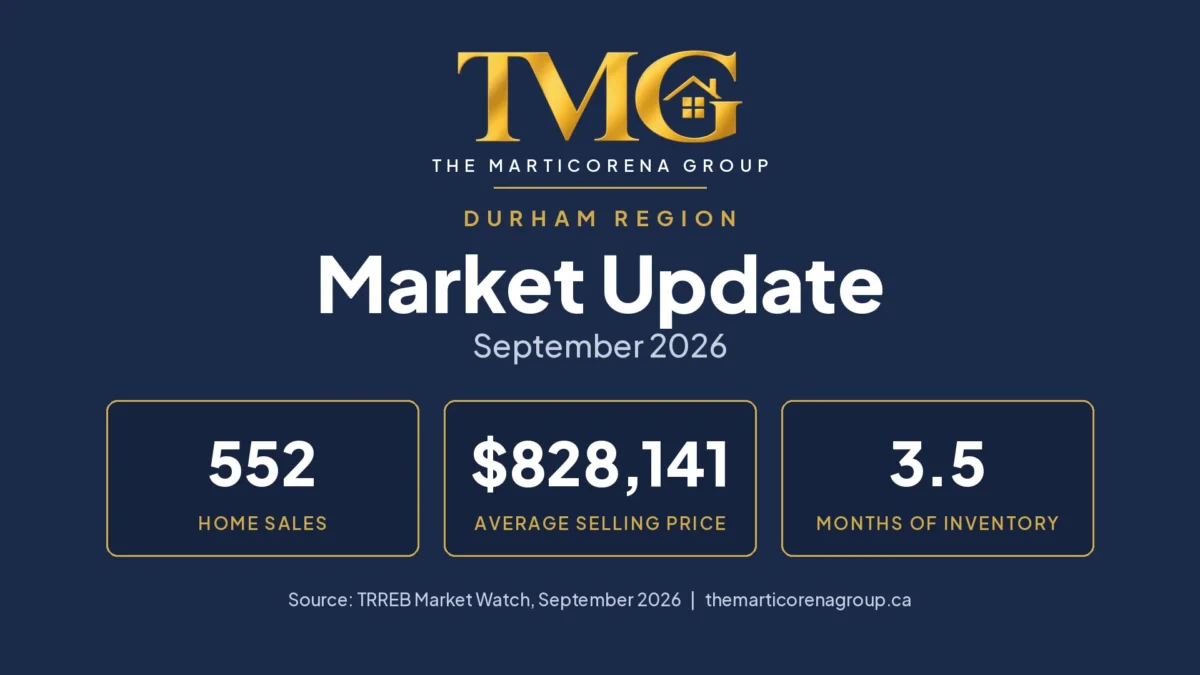
Our September 2026 Durham Region market update gives the local picture just before this decision:
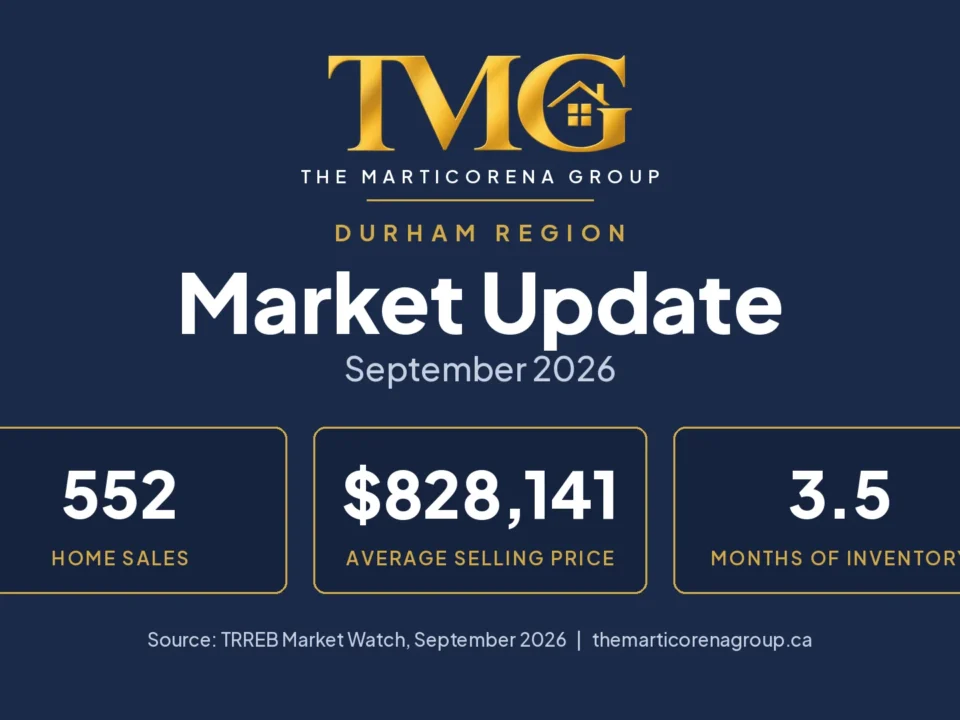
- 552 homes sold in Durham, about 22% fewer than last September.
- The average selling price was $828,141, about 6% lower than a year earlier.
- There were 3.5 months of inventory, up from 3.1. Buyers had more choice than a year ago, though Durham was still tighter than TRREB’s overall market area (4.6).
- Homes that sold went for about 98% of their asking price on average.
To put the rate change in local terms, here is an illustration, not a typical Durham buyer’s mortgage: 20% down on Durham’s September average price means borrowing about $662,500. On a variable rate with an adjustable payment over 25 years, a quarter-point increase (3.95% to 4.20% in this example) adds roughly $90 a month. That excludes property taxes, insurance, utilities and maintenance, and actual payments depend on the lender’s terms.
What we can’t tell you yet is how buyers and sellers here are responding. Those numbers come from before the increase; October’s figures are expected from the Toronto Regional Real Estate Board in early November, and we’ll cover them in our October update.
If you have a variable-rate mortgage
First, check your statement or contract to see whether your payment adjusts when rates change or stays fixed.
- If your payment adjusts, expect a notice from your lender with the new amount, and update your budget.
- If your payment stays fixed, check how much of each payment is still going to principal. The Financial Consumer Agency of Canada warns that if rates rise far enough, none of your payment may go to principal and your balance can grow. If that is getting close, contact your lender early to discuss options.
If your mortgage renews in the next year
Three questions to ask your lender or a licensed mortgage professional:
- When can I review and lock in a renewal offer, and how long is that rate guaranteed? Federally regulated lenders, such as banks, must send a renewal statement at least 21 days before your term ends. The Financial Consumer Agency of Canada suggests starting to shop around a few months earlier, not waiting for the letter.
- Is this your best rate, and what would my monthly payment be on each option? Ask for fixed and variable side by side. The rate in your renewal letter isn’t always the lowest you can get, and if you do nothing, your mortgage may renew automatically.
- If I switch lenders, what will it cost and what do I need to qualify? At the end of your term you can move to another lender, but the new lender has to approve you, and there can be costs such as discharge, registration or appraisal fees (some lenders cover part of them). Borrowing more or extending your amortization can also bring a new mortgage insurance premium.
If you are buying
- Work from the monthly payment, including property taxes, not just the price.
- Read your pre-approval closely. It is not a final approval. Check how long the rate hold lasts and what conditions still apply, such as confirming your income, your down payment and the home itself.
- Remember the qualifying test. Lenders check that you could afford payments at a higher rate than the one you get, so even a small rate change can affect how much you qualify for. Our first-time buyer guide explains the basics.
If you are selling
Most buyers shop by monthly payment and by what they are approved for. When rates rise, some buyers’ budgets shrink and some decide to wait. There isn’t local data yet to say how Durham buyers are responding.
That is why your asking price should come from current comparable sales and the homes you would compete with nearby, not last spring’s prices. In September, Durham’s benchmark price was 5.2% lower than a year earlier.
TMG Perspective
Our read is that, for most households, this decision matters more as a signal than as a cost. For many owners, the bigger moment will be their renewal, when the rate on the whole mortgage is reset.
The signal is that rates can go up as well as down. The Bank has said more increases are possible, but it has not said they will happen, and nobody can tell you what December 9 will bring. Plans that only work if rates fall are worth a second look. Plans that would still work with a slightly higher rate are on firmer ground.
For buyers and sellers in Durham Region, local conditions matter as much as the rate. Good decisions come from numbers you can check: your actual payment, your actual approval and current comparable sales. Rate and product choices belong with a licensed mortgage professional; our role is the real estate side.
The takeaway
- Find out what kind of mortgage you have and when it renews.
- If your rate is variable, check your lender’s notice or statement for your new payment, or for how much is now going to interest.
- If you are renewing, buying or selling in the next year, run your numbers at today’s rate and at a slightly higher one.
Planning a move? Let’s look at your numbers.
If you are thinking of buying or selling in Durham Region or the GTA in the next year, we can help you see how today’s rates and today’s local market fit together:
- Buying: what homes in the areas you’re considering are actually selling for, so you can match your search to your pre-approval and your monthly budget.
- Selling: a pricing review based on current comparable sales and the competition near your home.
- Financing questions: an introduction to a licensed mortgage professional who can review your options.
No obligation. Email julie@themarticorenagroup.com or call (416) 526-3786.
Julie Marticorena, REALTOR®
The Marticorena Group | LPT Realty, Brokerage
julie@themarticorenagroup.com | (416) 526-3786 | themarticorenagroup.ca
More market coverage in our Market Updates archive.
About this article. The rate decision, inflation figures and next date are from the Bank of Canada’s October 28, 2026 rate announcement and Governor Tiff Macklem’s opening statement. The prime rate change is from National Bank of Canada’s October 28, 2026 announcement; RBC, TD, BMO, Scotiabank and CIBC announced the same change, all effective October 29, 2026. How mortgage rates are set is explained in the Bank of Canada’s What’s behind your mortgage rate. Renewal and variable-rate guidance is from the Financial Consumer Agency of Canada’s pages on renewing your mortgage and choosing a mortgage. Durham figures are from TRREB’s September 2026 Market Watch, as reported in our September update. Payment examples are TMG calculations for illustration only, using monthly compounding; with semi-annual compounding the figures are a few dollars lower. Information is current as of October 31, 2026 and is general information, not mortgage, legal or financial advice.
About the author. Julie Marticorena is a REALTOR® with The Marticorena Group serving Durham Region and the Greater Toronto Area. With more than 15 years of experience in financial services and a background in strategic planning, negotiation, and project management, Julie brings an analytical and organized approach to real estate. She focuses on education, transparency, and personalized guidance, helping buyers, sellers, and investors make informed real estate decisions with confidence. Julie is fluent in English and Spanish.