
If you are renting in Durham, or thinking about moving here from Toronto or elsewhere in the GTA, the first question is usually not “which house” but “can we actually do this?” This article answers it with the most recent verified numbers for Durham Region and the rules as they stand in September 2026: what a typical home costs, how much you need saved, and which programs put money back in your pocket. It is general information, not a pre-approval and not financial, legal or tax advice. When you are ready, a mortgage professional will run your actual numbers.
What a typical home costs in Durham right now
The best starting point is the MLS Home Price Index benchmark, published monthly by the Toronto Regional Real Estate Board: the price of a typical home of a given type in a given area, less distorted by a few unusual sales than an average is. For August 2026, the Durham Region benchmarks were:
| Home type (Durham Region) | August 2026 benchmark price |
|---|---|
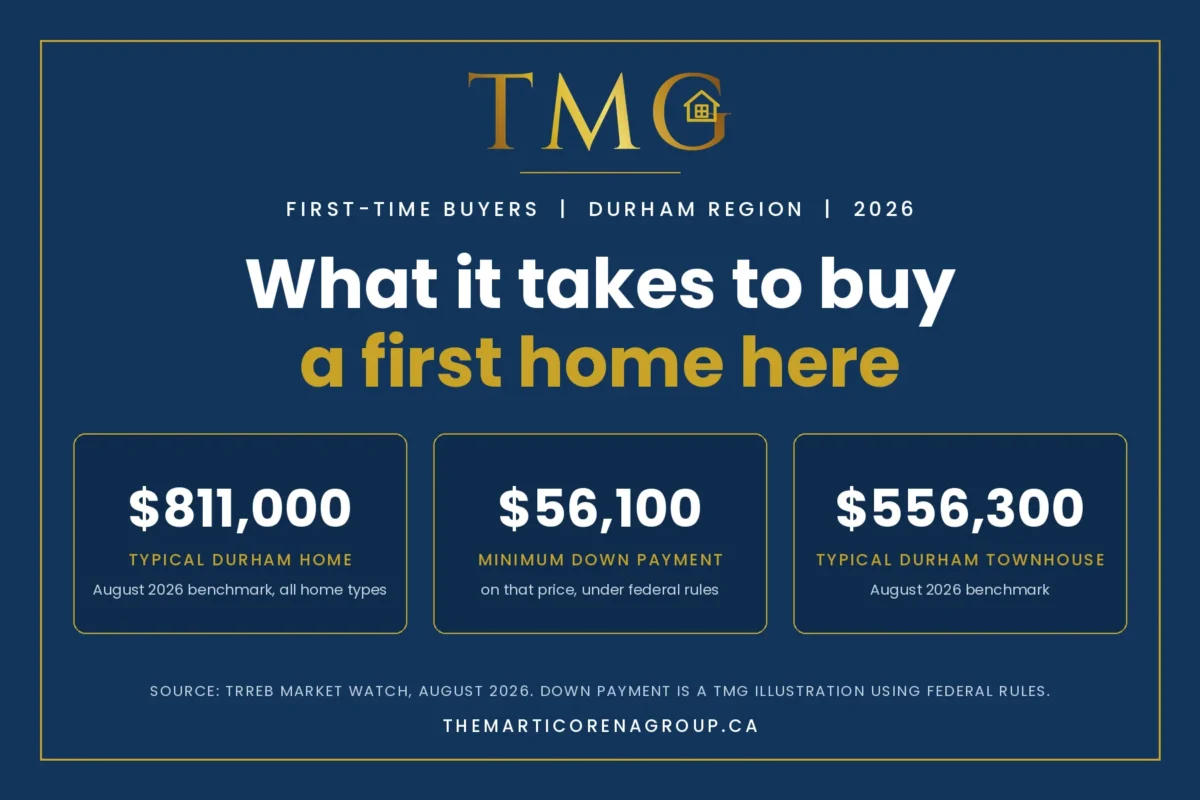
| All home types (composite) | $811,000 |
| Single-family detached | $889,700 |
| Single-family attached (semis, links) | $702,300 |
| Townhouse | $556,300 |
| Apartment | $463,200 |
Two things stand out. Prices are lower than a year ago: the composite benchmark was down 4.6% from August 2025. And the spread between home types is wide. A first home in Durham does not have to mean a detached house; the townhouse and apartment benchmarks sit roughly $250,000 to $350,000 below the composite, and that gap changes everything that follows.
The minimum down payment, applied to Durham prices
Canada’s minimum down payment rules (Financial Consumer Agency of Canada) are:
- 5% of the first $500,000 of the purchase price;
- 10% of the portion between $500,000 and $1,499,999;
- 20% of the whole price at $1.5 million or more.
With less than 20% down, the mortgage generally has to be insured. The premium (0.6% to 4.5% of the mortgage, depending on your down payment) is usually added to the mortgage balance, but in Ontario the sales tax on that premium is paid in cash at closing, so ask your broker or lawyer for the figure early.
Here is the minimum down payment against the August 2026 composite benchmark in each of Durham’s five largest municipalities. These are illustrations using a “typical home” price, not quotes for any specific property.
| Municipality | August 2026 composite benchmark | Minimum down payment | Ontario land transfer tax after first-time buyer refund |
|---|---|---|---|
| Oshawa | $705,200 | $45,520 | $6,579 |
| Clarington | $742,800 | $49,280 | $7,331 |
| Ajax | $838,800 | $58,880 | $9,251 |
| Pickering | $873,200 | $62,320 | $9,939 |
| Whitby | $908,000 | $65,800 | $10,635 |
| Durham Region (all) | $811,000 | $56,100 | $8,695 |
For a townhouse or an apartment, the numbers drop sharply: at the Durham townhouse benchmark of $556,300 the minimum down payment is $30,630, and at the apartment benchmark of $463,200 it is $23,160, with land transfer tax after the refund under $2,000.
Putting more down reduces both the mortgage and the premium, and 20% down removes the premium entirely, but on the composite benchmark that is about $162,000 in cash. How much to put down is a decision for you and your mortgage professional, not a rule.
The rules and programs worth knowing
The short version of each, with links for the full rules. Confirm what applies to you with your mortgage professional, lawyer or tax preparer.
30-year amortizations. Since December 15, 2024, first-time buyers, and anyone buying a newly built home, can take an insured mortgage over 30 years instead of 25: a lower monthly payment, more total interest over the life of the mortgage.
The $1.5 million insured cap. The same reform raised the maximum price for an insured mortgage from $1 million to $1.5 million. The Durham benchmarks above are below $1 million, but the higher cap can still matter when considering more expensive properties with less than 20% down.
The stress test. You must qualify at the greater of your contract rate plus 2 percentage points or 5.25%, so a lender will approve less than your actual rate alone would suggest. A pre-approval tells you your real number.
First Home Savings Account (FHSA). Contributions are tax deductible and withdrawals for a qualifying first home are tax free: $8,000 a year, up to $40,000 lifetime, with unused room carrying forward (up to $8,000). If your purchase is a year or more away, opening one now starts building room.
Home Buyers’ Plan (HBP). Withdraw up to $60,000 from your RRSP tax free toward a first home and repay it over 15 years; for withdrawals made between 2026 and 2028, repayment starts in the fifth year after the withdrawal year. The CRA confirms the HBP and an FHSA can be combined for the same home.
Home Buyers’ Amount. A federal non-refundable tax credit on a $10,000 claim in the year you buy, if neither you nor your spouse lived in a home you owned that year or the four years before.
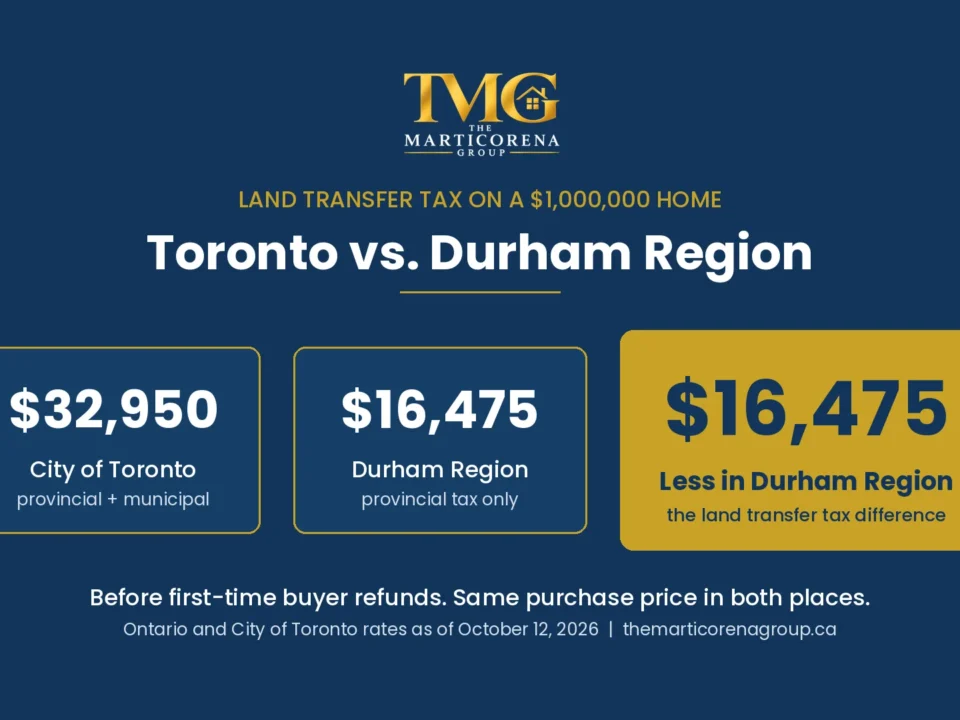
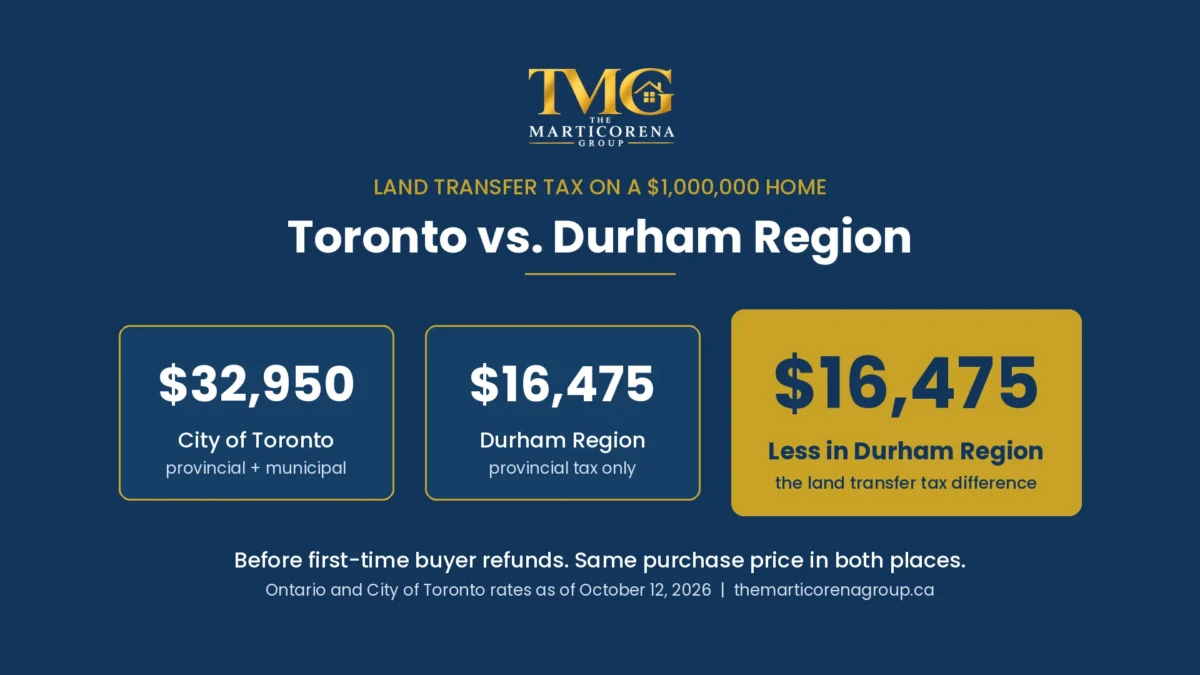
Ontario land transfer tax refund. Up to $4,000 for first-time buyers who are at least 18, have never owned a home anywhere in the world, are Canadian citizens or permanent residents, and move in within nine months. It is normally applied at closing, which is why the table above shows the tax net of the refund. One Durham advantage: Toronto’s municipal land transfer tax applies only inside the City of Toronto, so in Pickering, Ajax, Whitby, Oshawa or Clarington you pay the provincial tax once, not twice.
Buying new? The first-time buyer GST/HST rebate. On a newly built or substantially renovated first home, the federal rebate returns the GST portion of the price, up to $50,000 on homes valued at or below $1 million, phasing out to nothing at $1.5 million. It does not apply to resale homes. Ontario has separately introduced temporary relief on the provincial part of the HST for new homes. We explained the federal rebate and Ontario’s HST relief in earlier articles; confirm the agreement-date windows with your lawyer before you sign.
What this means for you: the TMG perspective
In practice, a typical Durham townhouse means roughly $31,000 as a minimum down payment and the composite benchmark closer to $56,000, plus land transfer tax after the refund and the other closing costs listed below. Ask your lawyer for a written closing cost estimate rather than guessing.
The market itself is giving first-time buyers something they did not have a few years ago: choice, and time to use it. In August, Durham had 3.4 months of inventory on TRREB’s trend measure, meaning that at the current pace of sales it would take about three and a half months to sell the homes available if nothing new were listed. The lower that number, the more competition buyers face; the higher, the more choice. In February 2022, near the peak of the pandemic-era market, Durham had 0.5 months of inventory, 605 homes for sale, and homes selling at 129% of asking on average; in August 2026 there were 2,467 homes for sale and homes sold at about 98% of asking. None of that guarantees where prices go next, and TMG does not forecast. What it does mean is that many well-prepared buyers have more room to view homes carefully, consider inspections and negotiate terms than they did during the most competitive pandemic-era market.
One caution: TRREB’s 46-day average for homes sold in Durham in August is a property days on market figure, which counts relistings of the same property. It is a regional average, not a prediction for any one home, and not a complete history of how long a property has been for sale.
Your first-home starting checklist
- Get a mortgage pre-approval. It tells you your real purchasing range under the stress test.
- Add up your available down payment, including FHSA and HBP funds where they apply, plus any gift or savings.
- Build a closing-cost budget on top of the down payment: land transfer tax after the refund, legal fees, title insurance, the sales tax on the insurance premium, inspection and moving.
- Decide which Durham communities and home types fit that budget. The tables above are a starting point.
- Then start viewing homes. With the money sorted first, the search is about the home, not the financing.
A low-pressure next step
If you are working out whether a first home in Durham is realistic this year or next, I am happy to talk it through, with no obligation. I can help you understand Durham’s communities and the housing options in each, turn an approved budget into a realistic search, and connect you with a mortgage professional who will calculate your actual financing numbers. Email julie@themarticorenagroup.com, call (416) 526-3786, or visit https://themarticorenagroup.ca. For how each community compared last month, read the Durham Region Real Estate Market Update: August 2026.
About the numbers: benchmark prices, months of inventory, active listings, sale-to-list ratio and days on market are from the Toronto Regional Real Estate Board’s Market Watch reports for August 2026 and, for the 2022 comparison, February 2022. Down payment, mortgage insurance, stress test and program figures are from the Department of Finance Canada, the Financial Consumer Agency of Canada, OSFI, the Canada Revenue Agency and the Ontario Ministry of Finance, as published at the time of writing. Down payment and land transfer tax figures in the tables are TMG calculations applying those rules to the benchmark prices; they are illustrations, not quotes. This article is general information, not mortgage, legal, tax or financial advice. Rules and rates change; confirm the details that apply to you with a licensed mortgage professional and your lawyer.
Julie Marticorena is a REALTOR® with The Marticorena Group serving Durham Region and the Greater Toronto Area. With more than 15 years of experience in financial services and a background in strategic planning, negotiation, and project management, Julie brings an analytical and organized approach to real estate. She focuses on education, transparency, and personalized guidance, helping buyers, sellers, and investors make informed real estate decisions with confidence. Julie is fluent in English and Spanish.