
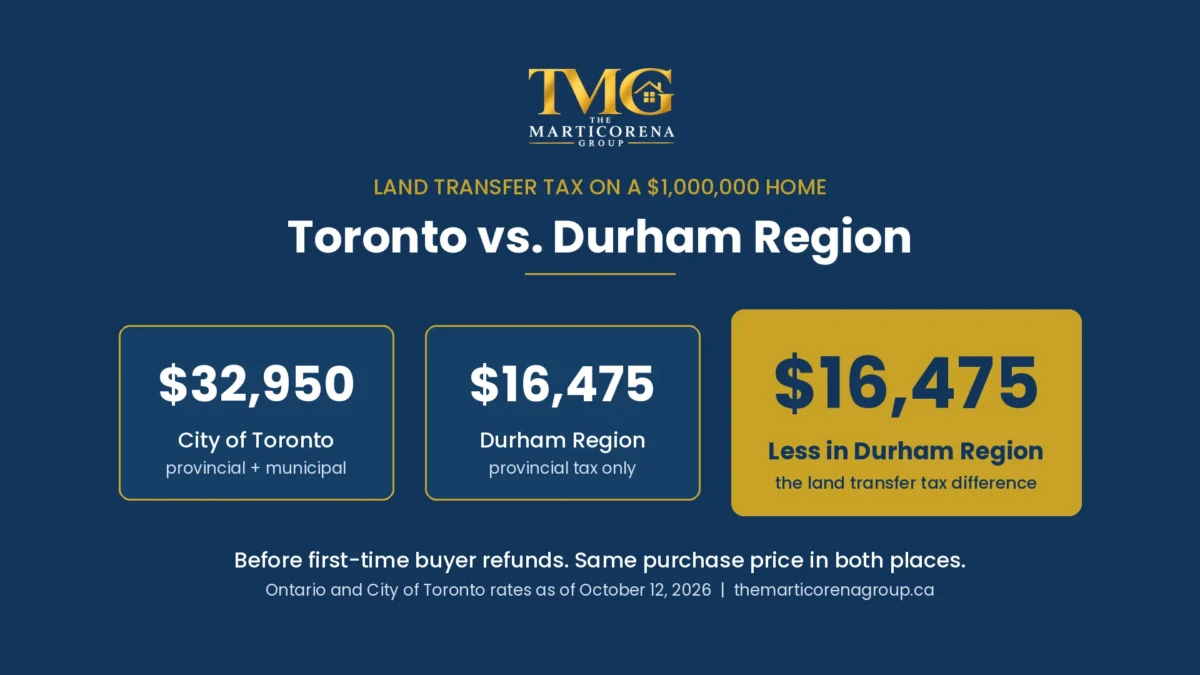
If you’re thinking about buying in Durham Region instead of the City of Toronto, one of the biggest differences shows up before you even get the keys: land transfer tax. Buyers in Toronto pay two land transfer taxes, the provincial tax and the City’s municipal tax. Buyers in Durham Region pay only the provincial tax.
On a $1,000,000 home, that difference is $16,475 in land transfer tax.
Here’s how it works, what it looks like at a few common prices, and what to keep in mind if you’re comparing homes on both sides of the boundary.
What land transfer tax is
Land transfer tax is a one-time tax you pay when you buy a home in Ontario. It’s based on the purchase price and it’s due when the sale closes. It’s usually paid from your own funds, not added to your mortgage, so it matters a lot when you’re working out how much cash you need to buy.
Every buyer in Ontario pays the provincial land transfer tax. The City of Toronto is the only municipality in Ontario that charges its own land transfer tax on top of that. Durham Region and its municipalities, including Pickering, Ajax, Whitby, Oshawa and Clarington, do not.
How the two taxes are calculated
For a home with one or two single-family residences, both taxes use the same rates up to $2 million:
- 0.5% on the first $55,000
- 1% on the portion from $55,000 to $250,000
- 1.5% on the portion from $250,000 to $400,000
- 2% on the portion from $400,000 to $2,000,000
On the portion above $2 million, the provincial rate is 2.5%, and Toronto’s rate is also 2.5% up to $3 million. Since April 1, 2026, Toronto charges higher rates on the portion above $3 million, rising in steps from 4.4% to 8.6% for the portion above $20 million.
Because the rates match for any home up to $3 million, a Toronto buyer’s municipal tax is exactly the same amount as the provincial tax. In plain terms, the land transfer tax bill doubles.
What the difference looks like
| Purchase price | Durham Region (provincial tax only) | City of Toronto (provincial + municipal) | Difference |
|---|---|---|---|
| $650,000 | $9,475 | $18,950 | $9,475 |
| $830,000 | $13,075 | $26,150 | $13,075 |
| $1,000,000 | $16,475 | $32,950 | $16,475 |
| $1,300,000 | $22,475 | $44,950 | $22,475 |
Calculated by The Marticorena Group from the Ontario and City of Toronto rates in effect on October 12, 2026, for a home with one or two single-family residences. Each row assumes the same purchase price in both places and is before any first-time buyer refund. The difference is in land transfer tax only, not the total cost of buying or moving.
For context, $830,000 is close to Durham Region’s average selling price in September 2026, which TRREB reported at $828,141 (see our September 2026 Durham Region Market Update).
If you’re a first-time buyer
First-time buyers get some relief in both places, but it doesn’t close the gap.
- Ontario refunds up to $4,000 of the provincial tax. That covers the full tax on roughly the first $368,000 of the price.
- Toronto rebates up to $4,475 of its municipal tax, which covers the full tax on the first $400,000.
After both refunds, a first-time buyer would pay $9,075 in land transfer tax on an $830,000 home in Durham Region, compared with $17,675 in Toronto. On a $1,000,000 home, it’s $12,475 compared with $24,475.
To qualify for Ontario’s refund, you must be at least 18, a Canadian citizen or permanent resident, never have owned a home anywhere in the world, and move in as your principal residence within nine months. If your spouse owned a home while you were spouses, neither of you qualifies. The refund can be claimed when the purchase is registered, or by applying within 18 months. If a co-buyer isn’t a first-time buyer, the refund is reduced to the first-time buyer’s share.
Toronto’s rebate has its own application, but its main rules match the province’s: age 18 or over, Canadian citizen or permanent resident, no past home ownership anywhere for you (or your spouse while you were spouses), and moving in within nine months. If it isn’t claimed at registration, the application must reach the City within 18 months.
Your real estate lawyer can confirm how the refunds will be claimed on your purchase. Our first-time buyer guide shows the provincial tax after the refund for each Durham community.
A note on Toronto’s rates
Toronto’s municipal land transfer tax has been part of the discussion ahead of the October 26, 2026 municipal election. On September 30, 2026, TRREB called on Toronto candidates to commit to reducing it. The figures in this article use the rates in effect on October 12, 2026. Before you buy, check the City of Toronto’s current rates.
TMG Perspective
It’s a real saving, but it’s one piece of the picture. Land transfer tax is a one-time cost. Over the years you own a home, the purchase price, your mortgage, property taxes, commuting and how the area fits your life will matter more. A lower land transfer tax doesn’t make every Durham home a better deal than every Toronto home.
It changes how much cash you need at closing. This is where buyers feel it most. Thousands of dollars less in closing costs can mean more room for your down payment, moving costs or a cushion after you move in.
Run the numbers on the actual homes you’re considering. If you’re comparing a home in Scarborough with one in Pickering, for example, look at the full cost of each: price, land transfer tax, legal fees, property taxes and the commute. That’s the comparison that tells you what the move really saves.
What this means for you
- Buying in Durham Region: budget for the provincial land transfer tax only, and ask your lawyer for a closing-cost estimate early.
- Buying in Toronto: budget for both taxes. On most homes, that’s double the provincial amount.
- First-time buyers: confirm you qualify for the refunds before you make an offer, so your cash plan is accurate.
Comparing homes in Toronto and Durham Region?
If you’re weighing a home in Toronto against one in Durham Region, I can put together a personalized closing-cost comparison for the homes you’re actually considering: land transfer tax, any first-time buyer refunds, and the other costs to plan for at closing. Just reach out, no obligation.
Julie Marticorena, REALTOR®
The Marticorena Group | LPT Realty, Brokerage
julie@themarticorenagroup.com | (416) 526-3786 | https://themarticorenagroup.ca
More in our Buying a Home archive.
About this article. Provincial rates are from the Government of Ontario’s land transfer tax calculation page and its first-time homebuyer refund page. Toronto rates and the first-time buyer rebate are from the City of Toronto’s MLTT rates page and rebate page. The Durham average price is from TRREB’s September 2026 Market Watch. TRREB’s position on Toronto’s tax is from its September 30, 2026 article. Information is current as of October 12, 2026 and is general information, not legal or tax advice. Your lawyer will confirm the exact amount for your purchase.
About the author. Julie Marticorena is a REALTOR® with The Marticorena Group serving Durham Region and the Greater Toronto Area. With more than 15 years of experience in financial services and a background in strategic planning, negotiation, and project management, Julie brings an analytical and organized approach to real estate. She focuses on education, transparency, and personalized guidance, helping buyers, sellers, and investors make informed real estate decisions with confidence. Julie is fluent in English and Spanish.