

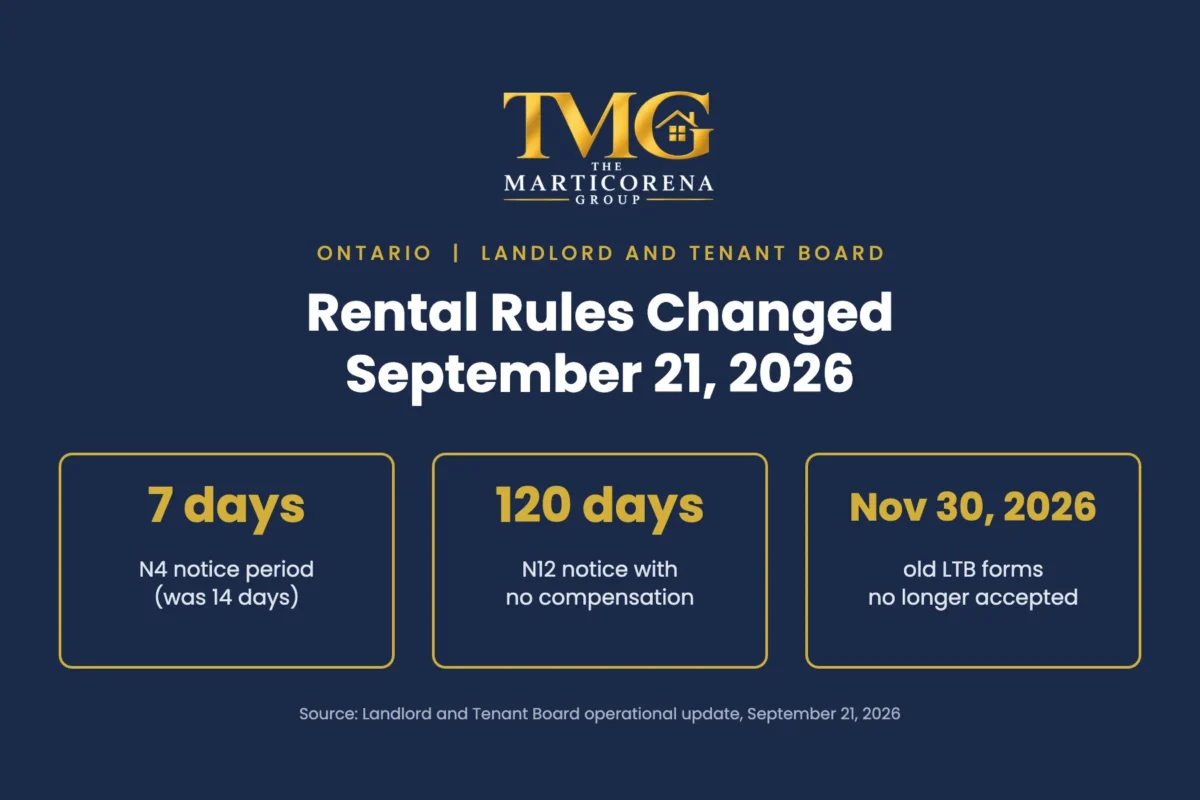
On September 21, 2026, changes to Ontario’s rental rules took effect at the Landlord and Tenant Board (LTB). They come from two provincial laws, Bill 60 (2025) and Bill 97 (2023), and they touch the notices landlords and tenants actually run into: unpaid rent, late rent, a landlord moving into their own property, and renovations.
“Landlords can now evict in seven days” is the one we hear most, and it is not an accurate description of the change. The seven days is the notice period on an N4 for unpaid rent. It is not the whole eviction process, which still runs through an LTB application, a hearing and an order. Here is what changed, what did not, and what it means for landlords and tenants in Durham Region, the GTA and across Ontario. This is general information, not legal advice.
The changes at a glance
| Topic | What changed on September 21, 2026 | Who it applies to |
|---|---|---|
| Unpaid rent (N4 notice) | Notice period shortened from 14 days to 7 days | N4 notices given on or after September 21, 2026 |
| Raising other issues at a rent-arrears hearing | Tenant must pay the landlord half of the arrears claimed, at least 7 days before the hearing, to raise maintenance or tenant-rights issues | Landlord applications filed on or after September 21, 2026 |
| Persistent late payment (N8 notice) | Now defined: rent received more than 7 days late at least 3 times within 6 months | Effective September 21, 2026 |
| Landlord’s own use (N12 notice) | With at least 120 days’ notice, no compensation or alternative unit is required | Landlord’s own use N12s given on or after September 21, 2026. Not purchaser’s own use. |
| Moving in after an N12 | Landlord or family member must normally move in within 60 days of the termination date, or bad faith is presumed | Landlord’s own use N12s. Not purchaser’s own use. |
| Renovations (N13 notice) | Landlord must keep a returning tenant informed and give 60 days’ notice to move back in; longer T5 deadline | Work completed on or after September 21, 2026 |
| LTB forms | N4, N5, N6, N8, N12, N13, L1, L2, L9, L10 and T5 updated | Old versions not accepted as of November 30, 2026 |
Source: Landlord and Tenant Board operational update, September 21, 2026.
1. Unpaid rent: the N4 notice is now 7 days, not 14
For N4 notices given on or after September 21, 2026, the termination date can be as early as 7 days after the notice is given, instead of 14.
That does not mean a tenant can be removed after seven days. The N4 is a notice, not an eviction order. If the tenant pays everything owed before the landlord files with the LTB, the notice is void. If rent is still unpaid after the termination date, the landlord can file an L1 application, a hearing is scheduled, and only then can an eviction order be issued. In most cases the tenant can still stop the eviction by paying the full amount in the order by its deadline. What changed is that the clock to the first filing step is one week shorter.
2. Raising other issues at a rent-arrears hearing
Tenants can still raise their own issues, such as maintenance problems, at a hearing about unpaid rent. For landlord applications filed on or after September 21, 2026, there is a new condition: the tenant must pay the landlord half of the arrears claimed in the application at least seven days before the hearing, in addition to the existing rule that the issues be described in writing to the landlord and the LTB at least seven days ahead. The payment goes directly to the landlord, not to the LTB in trust, so keep a receipt. A tenant can still dispute the arrears themselves, and the separate tenant applications for maintenance and other problems still exist.
3. “Persistent late payment” now has a definition
For an N8 notice, “persistently” late was a judgment call. As of September 21, 2026, it is defined: rent received more than seven days after the due date at least three times within a six-month period. A payment does not count as late if the landlord applied it to something else the tenant owed, and the LTB says a tenant may still be found persistently late in other circumstances. An N8 still leads to an application and a hearing, not an automatic eviction.
4. Landlord’s own use (N12): 120 days’ notice and compensation
An N12 is the notice a landlord gives when they, an immediate family member or a caregiver intends to move in. It still requires at least 60 days’ notice ending on the last day of a rental period, and the person moving in still signs an affidavit.
Until now, that landlord had to pay the tenant one month’s rent or offer another acceptable unit. For N12s given on or after September 21, 2026, that requirement does not apply if the landlord gives at least 120 days’ notice, again ending on the last day of a rental period. Give the standard 60 days and compensation is still owed. This applies only to landlord’s own use, not to an N12 given because a purchaser wants to move in (see the buying and selling section below).
5. Moving in within 60 days
For a landlord’s own use N12, the landlord or the specified family member or caregiver must normally take occupancy within 60 days of the termination date in the notice. If they do not, and the former tenant files a T5 (bad-faith notice) application, the LTB presumes the notice was given in bad faith. That presumption is not automatic proof; the landlord can explain what happened at the hearing and rebut it. The LTB states this does not apply to purchaser’s use N12s.
6. Renovations (N13): keeping a returning tenant informed
A tenant who gives written notice before moving out for an N13 has the right to move back in when the work is done. The landlord must now, without delay, tell the tenant in writing the estimated completion date, tell them if it changes, tell them in writing when the unit is ready, and, where the work is completed on or after September 21, 2026, give 60 days’ notice to reoccupy. If the landlord did not provide that information or the 60 days, the LTB presumes the right of first refusal was not honoured, which the landlord may rebut. The tenant’s deadline to file a T5 is also longer: two years after moving out, or six months after the renovations are finished, whichever is later.
7. Updated forms
The LTB released updated N4, N5, N6, N8, N12, N13, L1, L2, L9, L10 and T5 forms on September 21, 2026. Previous versions will no longer be accepted as of November 30, 2026. Do not use a saved copy or an old template; download the current form from the Tribunals Ontario website each time.
What has not changed
- An N4, N8, N12 or N13 is a notice, not an eviction order. Where an eviction order is needed, the landlord must apply to the LTB, a hearing is held, and the LTB decides.
- Landlords still cannot change the locks, remove belongings or physically remove a tenant. Only the Court Enforcement Office (the Sheriff) enforces an eviction order.
- Tenants can still respond to and dispute an application at the hearing, and can still bring their own applications, including a T5 for a bad-faith notice.
What this means for landlords and tenants in Durham Region and the GTA
Whether the rental is a basement apartment in Ajax, a condo in Pickering, a house in Whitby or Oshawa, or a unit elsewhere in the GTA, the same practical points apply.
For landlords: timelines at the front of the process are shorter, so keep clean records of rent received and when. Use the current LTB form every time. If you plan to move into your own rental, decide early whether you are giving 120 days’ notice (no compensation) or 60 days (compensation owed), and be realistic about the 60-day move-in expectation. If you are renovating, keep a written trail of every notice to a tenant who wants to return.
For tenants: the main change is speed at the front of the process, not at the end. Watch the dates on any notice, keep proof of every payment, and treat an N12 or N13 as the start of a process, not the end of your tenancy. If you want to raise maintenance issues at an arrears hearing, plan for the half-payment rule and the seven-day timing.
Buying or selling a home with a tenant in place
When a tenant-occupied home is sold and the buyer wants to live in it, the notice is still an N12, but it is given for the purchaser’s own use. That route is only available when the property has three or fewer residential units, the notice is at least 60 days ending on the last day of a rental period, and the purchaser (or their family member or caregiver) signs the affidavit. One month’s rent in compensation still applies. The new 120-day exemption and the 60-day occupancy presumption do not.
So a seller cannot give a landlord’s own use N12 to clear the unit for a buyer; the notice has to match who is actually moving in. Buyers who want vacant possession should build the notice period, the compensation and the possibility of a hearing into the closing timeline, not rely on a “vacant on closing” clause alone. Investors buying a tenanted property to keep as a rental are not affected; the tenancy continues on the same terms.
Our perspective at TMG: getting the offer, the notice requirements and the closing timeline aligned early can reduce the risk of problems later.
This article is general information, not legal advice. Outcomes depend on the facts, the dates and the specific notice or application involved. For advice on your situation, contact a licensed paralegal or lawyer, a community legal clinic, or the LTB.
Have a question about a rental property?
If you own a rental in Durham Region or the GTA, are thinking about buying or selling a tenant-occupied home, or want to understand what these changes mean for your plans, I am happy to talk it through with you, no obligation.
Julie Marticorena, REALTOR®
The Marticorena Group, LPT Realty, Brokerage
julie@themarticorenagroup.com | (416) 526-3786 | https://themarticorenagroup.ca
Related reading: Downtown Oshawa’s Foundry District: What 3,000 New Rental Homes Could Mean for Durham. More homeowner guidance in our Homeownership archive.
About this article. Rule descriptions are taken from the Landlord and Tenant Board’s operational update “Legislative Changes at the Landlord and Tenant Board, Effective September 21, 2026” (Tribunals Ontario, September 21, 2026), the LTB brochure “How a Landlord Can End a Tenancy” as updated for those changes, and the text of Bill 60, the Fighting Delays, Building Faster Act, 2025 (Legislative Assembly of Ontario). Interpretation and commentary are the opinion of The Marticorena Group and are not legal advice.
About the author. Julie Marticorena is a REALTOR® with The Marticorena Group serving Durham Region and the Greater Toronto Area. With more than 15 years of experience in financial services and a background in strategic planning, negotiation, and project management, Julie brings an analytical and organized approach to real estate. She focuses on education, transparency, and personalized guidance, helping buyers, sellers, and investors make informed real estate decisions with confidence. Julie is fluent in English and Spanish.


